Frequently Asked Questions
The most-asked questions about planets & stellar astronomy.
What exactly is planetary and stellar astronomy?
It is the branch of astronomy devoted to studying planets—both within our solar system and orbiting distant stars—alongside the formation, structure, and life cycles of stars. It blends celestial mechanics, astrophysics, and observational technique into a single discipline.
Who are the most influential figures in the history of this field?
Galileo Galilei transformed planetary observation in the early 1600s, while Edwin Hubble and Vera Rubin reshaped our understanding of stellar systems and galactic dynamics in the 20th century. In the modern era, the teams behind the Kepler space telescope and the James Webb Space Telescope have expanded the field's reach enormously.
Where should a complete beginner start learning?
A solid first step is learning the layout of our own solar system and the basic stellar classification sequence (O through M). From that foundation, branching into exoplanet detection methods or stellar evolution gives a well-rounded picture of the field.
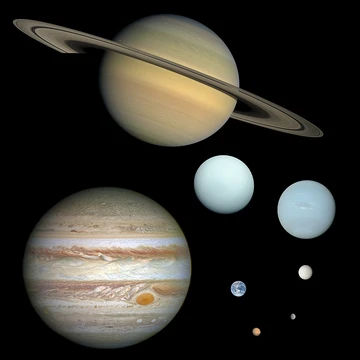
How many planets does our solar system officially have?
Eight—Mercury through Neptune—following the 2006 IAU reclassification that moved Pluto into the dwarf-planet category. The system also contains dozens of recognized dwarf planets, hundreds of moons, and countless asteroids and comets beyond those eight.
What is the full lifecycle of a typical star?
A star condenses from a collapsing cloud of gas and dust, ignites hydrogen fusion on the main sequence, swells into a red giant, and eventually sheds its outer layers to leave behind a white dwarf. More massive stars skip the white-dwarf stage entirely, ending in a supernova that produces a neutron star or a black hole.
What distinguishes a planet from a star?
A star generates its own light and heat through nuclear fusion in its core, whereas a planet merely reflects starlight and lacks the mass required to sustain fusion. This fusion criterion is the fundamental dividing line used in the IAU's working definitions.
What was one of the most significant milestone moments in modern planetary and stellar astronomy?
The 1995 detection of 51 Pegasi b—the first confirmed exoplanet orbiting a sun-like star—shattered the long-held assumption that stars like ours might lack planetary companions. It opened the door to the thousands of exoplanet discoveries that followed in the decades since.
How many exoplanets have been confirmed to date?
As of the mid-2020s, well over 5,700 exoplanets have received official confirmation, with the transit method accounting for the majority. The tally keeps climbing as missions like TESS and numerous ground-based surveys add new candidates every month.
What are the main categories of stellar remnants?
White dwarfs are the cooled, electron-degenerate cores of low- to medium-mass stars; neutron stars are the ultra-dense cores left after a core-collapse supernova; and black holes form when the remnant core exceeds roughly three solar masses. Each represents a different endpoint of stellar evolution.
What is the most practical way for a hobbyist to get involved?
Starting with a pair of binoculars or a modest 6-to-8-inch reflector telescope lets you observe the Moon, the gas giants, and bright star clusters with your own eyes. Pairing that with free tools like Stellarium or the NASA Exoplanet Archive makes it easy to connect what you see to the broader research community.