Planetary system
A star's family of orbiting worlds and debris.

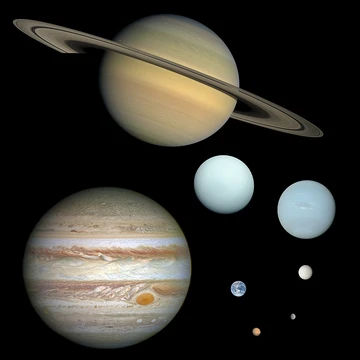
A planetary system is a set of non-stellar bodies gravitationally bound to and in orbit of a star or star system. Such systems include planets and may also contain dwarf planets, asteroids, natural satellites, meteoroids, comets, planetesimals, and circumstellar disks. The Solar System is an example, with Earth, seven other planets, and other objects revolving around the Sun. The term exoplanetary system is used for systems other than the Solar System, and by convention they are named after their host star.
Lore & Background
Heliocentrism, placing the Sun at the center, was first proposed in Western philosophy by Aristarchus of Samos in the 3rd century BC but received little support. Later, Galileo Galilei, Johannes Kepler, and Isaac Newton developed physics that led to acceptance that Earth orbits the Sun and planets follow the same physical laws.
Reader's Guide
Planetary systems are fundamental to understanding the cosmos and the potential for life. The Solar System serves as the archetype, but observations reveal diverse architectures: many systems host multiple Super-Earths in close orbits or hot Jupiters, while configurations like the Solar System's inner rocky and outer giant planets appear uncommon. The habitable zone, where liquid water could exist, is of particular interest to astrobiology. The study of planetary systems has evolved from ancient speculation to a data-rich field, driven by missions like Kepler and advances in detection methods. Their formation from protoplanetary disks and evolution through stellar life cycles—including planet capture, ejection, and engulfment—reveal the dynamic nature of these systems.
Did You Know?
- The first confirmed exoplanets were discovered in 1992 orbiting the pulsar PSR B1257+12.
- The Solar System is named after 'Sol,' the Latin word for sun.
- Planetary systems can form around pulsars from fallback disks of matter after a supernova.
Anatomy of a Planetary System
A planetary system, as defined by the International Astronomical Union, encompasses the collection of planets orbiting one or more stars, brown dwarfs, or stellar remnants. Broader definitions extend this to every body gravitationally tethered to a central star or star system. In practice, such a system typically contains planets alongside a rich menagerie of smaller objects: dwarf planets, asteroids, natural satellites, meteoroids, comets, planetesimals, and circumstellar disks. The Solar System serves as our nearest example, with Earth and seven companion planets revolving around the Sun, which carries the Latin name Sol. By long-standing convention, every planetary system takes its name from its parent star. When astronomers discuss such systems beyond our own, the term exoplanetary system is often employed to distinguish them. The Solar System itself is formally recognized by both the IAU and NASA as a planetary system, anchoring the concept in a concrete, well-studied case that has guided astronomical inquiry for centuries.
From Ancient Speculation to Mathematical Model
The notion that Earth and its planetary companions orbit the Sun rather than the reverse has deep roots. As early as the third century BC, the Greek astronomer Aristarchus of Samos proposed a heliocentric arrangement in Western philosophy, though his contemporaries largely dismissed the idea. Some scholars have also read an implicit heliocentric tilt into the writings of the Indian mathematician Aryabhatta, though that interpretation remains contested. The concept gained its first rigorous mathematical formulation in 1543, when Nicolaus Copernicus published De revolutionibus orbium coelestium, offering a predictive heliocentric model. Over the following century, Galileo Galilei, Johannes Kepler, and Sir Isaac Newton built the physical framework that gradually convinced the scientific community that Earth is merely another planet governed by the same laws as its neighbors. Even earlier, the sixteenth-century philosopher Giordano Bruno had speculated that distant fixed stars might each host their own planetary retinues, a thought Newton echoed in the General Scholium appended to his Principia. Through the nineteenth and twentieth centuries, such conjectures flourished in popular imagination and science fiction long before any observational proof existed.
Confirming Worlds Beyond the Sun
For centuries the existence of planets around other stars remained pure speculation, but the twentieth century delivered the first hard evidence. In 1992, astronomers confirmed several terrestrial-mass planets circling the pulsar PSR B1257+12, marking the inaugural verified detection of an exoplanet. Just three years later, in 1995, a giant planet designated 51 Pegasi b was found completing a remarkably short four-day orbit around the nearby G-type star 51 Pegasi—the first confirmed exoplanet around a main-sequence star. Detection rates have surged since, driven by refined observational techniques and dedicated surveys such as the Kepler mission. As of 23 April 2026, the confirmed tally stands at 6,416 exoplanets distributed across 4,809 distinct planetary systems, with 1,061 of those systems hosting more than one planet. Debris disks appear to be a common feature, while smaller objects remain harder to observe. Among all these discoveries, the habitable zone—where surface liquid water could persist and Earth-like life might conceivably arise—holds particular fascination for astrobiologists.
Birth, Fate, and Transformation
Every planetary system begins its life inside a protoplanetary disk of gas and dust that assembles around a newly forming star. During this turbulent construction phase, gravitational interactions scatter much of the material into distant orbits, and some planets are flung entirely out of the system to become free-floating rogue worlds. The eventual architecture depends heavily on the host star's mass. Around high-mass stars, supernova explosions can obliterate pre-existing planets, yet fallback disks of matter that failed to escape may seed new worlds around the resulting pulsar or even a black hole. Around lower-mass stars, the thinner disks make gas giants unlikely, so systems tend to be compact and dominated by rocky and icy bodies. As such stars age into red giants and asymptotic giant branch stars, they swallow their innermost planets, while surviving outer worlds drift farther out due to the star's mass loss. In binary or multiple-star configurations, mass transferred between companions can spawn fresh protoplanetary disks and second- or even third-generation planets with compositions distinct from their predecessors.
Frequently Asked Questions
What exactly is a planetary system?
A planetary system is a gravitationally bound collection of non-stellar bodies that orbit a central star or star pair. Our Solar System is the best-known example, with eight planets and countless smaller objects circling the Sun.
What kinds of objects can belong to a planetary system?
Beyond full-sized planets, these systems can host dwarf planets, asteroids, comets, meteoroids, natural satellites, and circumstellar disks of dust and gas. Essentially, any non-stellar body caught in the host star's gravitational grip qualifies.
How many confirmed exoplanetary systems exist as of 2026?
As of the latest data available in April 2026, astronomers have verified 6,416 exoplanets distributed across 4,809 distinct planetary systems. Of those, 1,061 systems contain more than one confirmed planet.
What's the difference between a planetary system and a star system?
A star system refers to one or more stars held together by gravity, whereas a planetary system specifically describes the smaller, non-stellar material—planets, moons, debris—revolving around that star or stellar pair. The two concepts overlap in practice, but the terminology separates the stellar component from the surrounding population of smaller bodies.
More in Planets & Stellar Astronomy 1-24
Spotted an error? Know more?
This is a living reference — every entry is fact-audited, and reader corrections feed straight into our audit queue. Suggest an edit · See this site's audit record